itzg/mc-router
Routes Minecraft client connections to backend servers based upon the requested server address.
1M+
itzg/mc-router repository overview





Routes Minecraft client connections to backend servers based upon the requested server address.
Usage
Flags:
  --help                     Show context-sensitive help (also try --help-long
                             and --help-man).
  --port=25565               The port bound to listen for Minecraft client
                             connections
  --api-binding=API-BINDING  The host:port bound for servicing API requests
  --mapping=MAPPING,MAPPING  Where MAPPING is externalHostname=host:port
REST API
GET /routesRetrieves the currently configured routesPOST /routesRegisters a route given a JSON body structured like:
{
  "serverAddress": "CLIENT REQUESTED SERVER ADDRESS",
  "backend": "HOST:PORT"
}
POST /defaultRouteRegisters a default route to the given backend. JSON body is structured as:
{
  "backend": "HOST:PORT"
}
DELETE /routes/{serverAddress}Deletes an existing route for the givenserverAddress
Docker Compose Usage
The following diagram shows how the example docker-compose.yml
configures two Minecraft server services named vanilla and forge, which also become the internal
network aliases. Notice those services don't need their ports exposed since the internal
networking allows for the inter-container access.
The router service is only one of the services that needs to exposed on the external
network. The --mapping declares how the hostname users will enter into their Minecraft client
will map to the internal services.
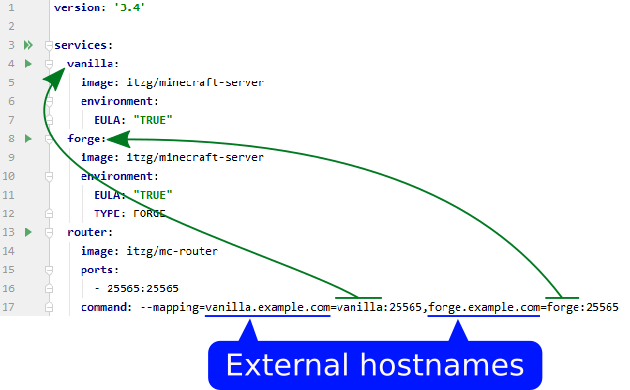
To test out this example, I added these two entries to my "hosts" file:
127.0.0.1 vanilla.example.com
127.0.0.1 forge.example.com
Kubernetes Usage
Using kubernetes service auto-discovery
When running mc-router as a kubernetes pod and you pass the --in-kube-cluster command-line argument, then
it will automatically watch for any services annotated with
mc-router.itzg.me/externalServerName: The value of the annotation will be registered as the external hostname Minecraft clients would used to connect to the routed service. The service's clusterIP and target port are used as the routed backend.mc-router.itzg.me/defaultServer: The service's clusterIP and target port are used as the default if no otherexternalServiceNameannotations applies.
For example, start mc-router's container spec with
image: itzg/mc-router
name: mc-router
args: ["--in-kube-cluster"]
and configure the backend minecraft server's service with the annotation:
apiVersion: v1
kind: Service
metadata:
  name: mc-forge
  annotations:
    "mc-router.itzg.me/externalServerName": "external.host.name"
Example kubernetes deployment
- Declares an
mc-routerservice that exposes a node port 25565 - Declares a service account with access to watch and list services
- Declares
--in-kube-clusterin themc-routercontainer arguments - Two "backend" Minecraft servers are declared each with an
"mc-router.itzg.me/externalServerName"annotation that declares their external server name
kubectl apply -f https://raw.githubusercontent.com/itzg/mc-router/master/docs/k8s-example-auto.yaml

Notes
- This deployment assumes two persistent volume claims:
mc-stableandmc-snapshot - I extended the allowed node port range by adding
--service-node-port-range=25000-32767to/etc/kubernetes/manifests/kube-apiserver.yaml
Tag summary
Content type
Image
Digest
sha256:74c0f682c…
Size
9.9 MB
Last updated
12 days ago
docker pull itzg/mc-routerThis week's pulls
Pulls:
13,703
Last week